Total Loss Threshold by State: 2026 Guide
Every state sets its own salvage rules, and they aren’t the same as when your insurer can total your car. Here’s the law in all 50 states.
Salvage Threshold vs. Total Loss: What's the Difference?
“Total loss threshold” is one of the most misunderstood terms in auto insurance. In most states, the percentage written into state law is a salvage title threshold: once repair costs pass it, the vehicle must be branded salvage. It is usually not the point at which your insurer must, or may, total your car. Insurers make that decision under your policy, typically using the total loss formula, and many vehicles are totaled well below the state’s percentage.
That distinction matters. Whether your car is repaired or totaled, the number that decides your settlement is its actual cash value, and that is the number insurers’ valuation reports most often get wrong. If you disagree with your settlement, your policy’s appraisal clause lets an independent, certified appraiser establish your vehicle’s true value, in any state.
How Insurers Decide Your Car Is Totaled
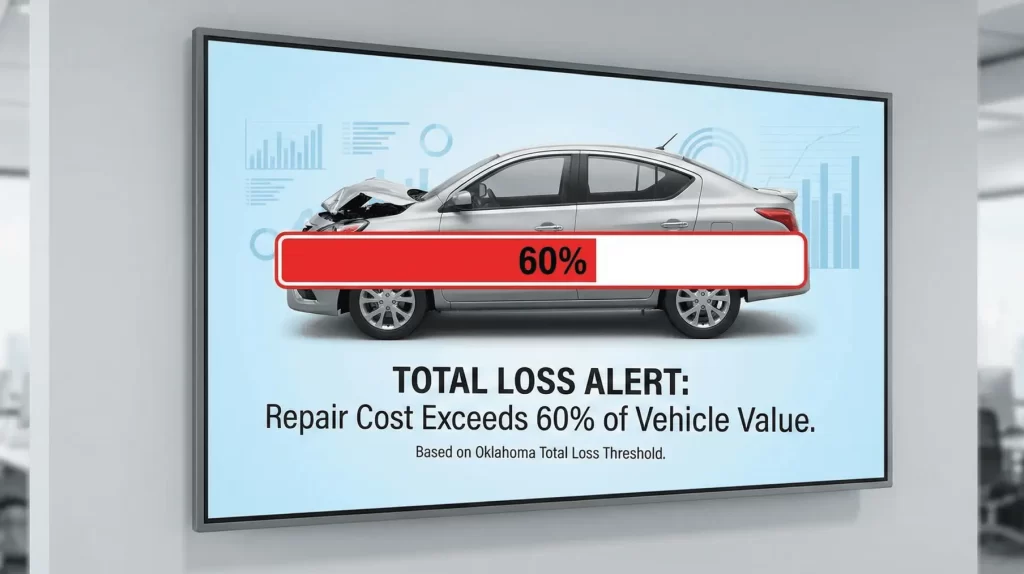
Most insurers use the total loss formula: if the cost of repair plus the vehicle’s salvage value is greater than its actual cash value (ACV), the car is totaled. For example, a car worth $10,000 with $5,000 in repairs and $6,000 in salvage value can be totaled even though repairs are only 50% of its value, because selling the salvage makes totaling it cheaper for the insurer.
A handful of states go further. North Carolina requires insurers to total vehicles at 75% of ACV, and Rhode Island generally prohibits insurers from totaling a vehicle below 85% of its value. Everywhere else, the decision rests mainly with the insurer, which is why the value they assign your car matters so much.
Once a total loss is declared, insurers often deploy flawed third-party valuation software to lower their payouts. These programs routinely pull mismatched “comparable” vehicles from outside your immediate driving region or apply subjective, penalizing condition deductions to lower your vehicle’s pre-accident value.
Activating your policy’s appraisal clause introduces an independent, certified appraiser to legally establish and enforce your vehicle’s true worth.
Total Loss Thresholds in All 50 States (and D.C.)
The table below shows each state’s salvage title threshold: the point at which state law requires a damaged vehicle to be branded salvage. In most states, this threshold does not control when your insurer can declare a total loss. Insurers can, and often do, total vehicles below it. States marked “No fixed %” leave the decision to the insurer’s economic analysis, usually the total loss formula: repair cost + salvage value compared to actual cash value. Last reviewed: October 2026.
| State | Salvage Threshold | Notes | Law |
|---|---|---|---|
| Alabama | 75% of fair retail value | Alabama law also defines a total loss at 75% | Ala. Code § 32-8-87 |
| Alaska | No fixed % | Repair cost exceeds vehicle’s worth | 2 AAC 92.170 |
| Arizona | No fixed % | Uneconomical to repair | A.R.S. § 28-2091 |
| Arkansas | 70% of average retail value | Water-damaged vehicles also qualify | Ark. Code § 27-14-2301 |
| California | No fixed % | Uneconomical to repair | Cal. Veh. Code § 544 |
| Colorado | No fixed % | Insurer total loss, or repair cost exceeds retail value | C.R.S. § 42-6-102 |
| Connecticut | No fixed % | Follows the total-loss determination | Conn. Gen. Stat. § 14-16c |
| Delaware | No fixed % | Salvage certificate after total-loss settlement | 21 Del. C. § 2512 |
| District of Columbia | 75% of fair market value | D.C. Code § 50-1331.01 | |
| Florida | No fixed % (insured vehicles) | Insurer total-loss payment; 80% applies to uninsured vehicles | Fla. Stat. § 319.30 |
| Georgia | No fixed % | Paid total loss, or two or more major components need replacement | O.C.G.A. § 40-3-2 |
| Hawaii | No fixed % | Uneconomical or impractical to repair | HRS § 286-2 |
| Idaho | No fixed % | Uneconomical to repair, or paid total loss | Idaho Code § 49-123 |
| Illinois | 33⅓% of fair market value | One of the lowest thresholds in the country | 625 ILCS 5/1-182 |
| Indiana | No single % | Insurer’s determination for vehicles within 7 model years; 70% in limited cases | Ind. Code § 9-22-3-3 |
| Iowa | 70% of fair market value | Iowa Code § 321.52 | |
| Kansas | 75% of fair market value | Late-model vehicles; cosmetic hail and wind damage excluded | K.S.A. 8-197 |
| Kentucky | 75% of retail value | Airbag reinstallation excluded from the calculation | KRS 186A.520 |
| Louisiana | 75% of market value | Hail-only cosmetic damage gets a hail brand instead | La. R.S. 32:702 |
| Maine | No fixed % | Follows insurer or owner total-loss declaration | 29-A M.R.S. § 602 |
| Maryland | 75% of fair market value | Towing, storage, rental and cosmetic repairs excluded | Md. Transp. § 11-152 |
| Massachusetts | No fixed % | Uneconomical to repair | M.G.L. c. 90D § 1 |
| Michigan | 75% to under 91% of ACV | 91% or more requires a scrap title (late-model vehicles) | MCL 257.217c |
| Minnesota | No fixed % (insured vehicles) | Insurer total-loss payment; 80% applies to self-insured vehicles | Minn. Stat. § 168A.151 |
| Mississippi | No fixed % | Salvage title after paid total-loss claim, with exceptions | Miss. Code § 63-21-33 |
| Missouri | 80% of fair market value | Vehicles within 6 model years; airbags, tires, sound systems and hail excluded | RSMo 301.010 |
| Montana | No fixed % | Follows insurer determination | MCA § 61-3-211 |
| Nebraska | 75% of retail value | Late-model vehicles | Neb. Rev. Stat. § 60-171 |
| Nevada | 65% of fair market value | NRS 487.790 | |
| New Hampshire | 75% of fair market value | Model year plus the following four years | RSA 261:22 |
| New Jersey | No fixed % | Damaged beyond economical repair | N.J.A.C. 13:21-22.3 |
| New Mexico | No fixed % | Uneconomical to repair, or insurer total loss | NMSA § 66-1-4.16 |
| New York | 75% of retail value | Vehicles 8 model years old or newer | 15 NYCRR 20.20 |
| North Carolina | 75% | Insurers must total at 75% of ACV; salvage brand for vehicles within 6 model years | N.C.G.S. § 20-71.3 |
| North Dakota | 75% of retail value | Glass and hail damage excluded | N.D.C.C. § 39-05-20.2 |
| Ohio | No fixed % | Follows insurer total-loss determination | ORC 4505.11 |
| Oklahoma | 60% of fair market value through Oct. 31, 2026; 70% from Nov. 1, 2026 | Vehicles within 10 model years (SB 1920) | 47 O.S. § 1111 |
| Oregon | No fixed % (insured vehicles) | Insurer total-loss declaration; 80% applies to uninsured damage | ORS 801.527 |
| Pennsylvania | No fixed % | Repair cost exceeds value after repair | 75 Pa.C.S. § 102 |
| Rhode Island | 85% insurer total-loss rule | Insurers generally may not total below 85% (eff. June 26, 2026); owner may elect at 75% | R.I. Gen. Laws § 27-9.1-4 |
| South Carolina | 75% of fair market value | S.C. Code § 56-19-480 | |
| South Dakota | No fixed % | Follows insurer total-loss determination | SDCL 32-3-51.19 |
| Tennessee | 75% of retail value | Tenn. Code § 55-3-201 | |
| Texas | 100% of actual cash value | Insurers may total earlier using economic analysis | Tex. Transp. Code § 501.091 |
| Utah | No fixed % | Insurer salvage declaration or major-component damage | Utah Code § 41-1a-1005 |
| Vermont | No fixed % | Insurer total loss or uneconomical to repair | 23 V.S.A. § 2001 |
| Virginia | 75% of actual cash value | Late-model vehicles acquired by insurers | Va. Code § 46.2-1602.1 |
| Washington | No fixed % | Total loss when repair cost plus salvage value meets or exceeds ACV | WAC 284-30-320 |
| West Virginia | 75% of market value | Flood-damaged vehicles also qualify | W. Va. Code § 17A-4-10 |
| Wisconsin | 70% of fair market value | Vehicles under 7 years old | Wis. Stat. § 340.01(55g) |
| Wyoming | 75% of actual cash value | Wyo. Stat. § 31-2-106 |
This chart is for general information, not legal advice. Thresholds often include exceptions for vehicle age, damage type, and how value is measured, and laws change. Check the current statute for your state, or contact us for a free claim review.
Can You Dispute a Total Loss Offer?
The Right to Your Own Appraisal: You are not required to accept the insurance company’s first offer.
- The Appraisal Clause: Most auto policies contain an “Appraisal Clause.” If you and the insurer disagree on the value, you can hire an independent appraiser (Ironclad Claims) to demand a fair settlement.
- Sales Tax & Fees: Many states require the insurer to include applicable sales tax, title, and registration fees in a total loss settlement. Check that yours did.
Why Your State’s Threshold Matters for Your Claim
Your state’s threshold affects whether a repaired vehicle will carry a salvage or rebuilt title, which can permanently lower its resale value. But once a vehicle is totaled, the entire claim turns on one number: the actual cash value. That is exactly the number insurers’ valuation reports tend to understate, through poorly matched comparables, unsupported condition deductions, and adjustments you never see explained.
State Guides
We handle total loss appraisals nationwide. For detailed guides, see our Oklahoma, Arkansas, Kansas, Missouri, and Texas pages, and our Oklahoma city pages for Oklahoma City, Tulsa, Norman, Broken Arrow, Edmond, Lawton, Moore, Midwest City, Enid, Stillwater, Owasso, Bartlesville, Muskogee, and Shawnee.
Why we outperform the competition
We know how total loss claims work in every state.
Local Market Data
We don't use national averages. We look at actual sales data from your local market to prove your car's value.
Expert Negotiation
We handle the "Umpire" process and communication with the insurance company.
Proven Results
Our clients see an average increase of $2,500 – $4,500 over the initial insurance offer.
How to dispute a total loss offer
- Contact Ironclad Claims Solutions for a free claim review to determine how much more we can increase your settlement.
- After the review, we will assist you with invoking your right to appraisal with your insurance company.
- Your insurance company will then be forced to step out of negotiations and hire a third-party independent appraiser who will work with us to reach an agreement on the value of your vehicle.
Total Loss FAQs
What is a total loss threshold?
The percentage of a vehicle's value at which state law requires it to be branded salvage. In most states, it doesn't control when an insurer can total your car.
Can my insurer total my car below my state's threshold?
In most states, yes. Insurers usually use the total loss formula, which compares repair cost plus salvage value to actual cash value. North Carolina and Rhode Island are notable exceptions.
Which states have the lowest and highest thresholds?
Illinois has one of the lowest at 33⅓% of fair market value. Texas uses 100% of actual cash value.