
Total Loss Appraisal: Get Paid What Your Vehicle Was Actually Worth
Did your insurance company lowball your total loss? A certified, independent appraiser can prove your vehicle’s true actual cash value and use your policy’s appraisal clause to close the gap.
Independent Total Loss Appraisal Services
When your insurance company declares your vehicle a total loss, your entire settlement comes down to one number: the vehicle’s actual cash value (ACV) right before the accident. Insurers don’t set that number by hand. They buy it from valuation software such as CCC One, Mitchell, or Audatex, and those reports routinely miss options, use poor comparable vehicles, and stack up deductions that push your offer down.
Ironclad Claims Solutions provides independent total loss appraisals for vehicle owners, not insurance companies. Our appraisers are certified through the Bureau of Certified Auto Appraisers, I-CAR Platinum, and ASE, and our reports follow USPAP, the professional standard for appraisals. We document what your vehicle was really worth, and when the insurer won’t move, we help you invoke your policy’s appraisal clause so the value is settled by appraisers instead of the adjuster.
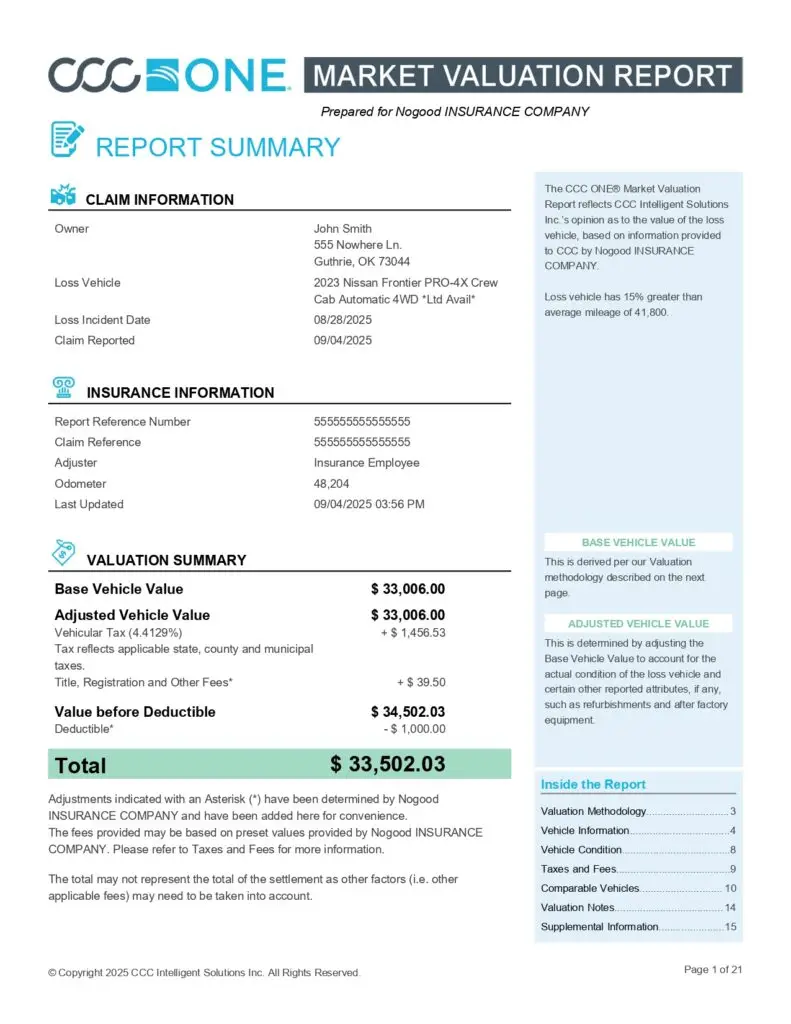
How Your Total Loss Settlement Is Calculated
A total loss settlement usually starts with the vehicle’s actual cash value, then adds or subtracts a few items:
- Actual cash value of your vehicle before the loss
- Plus sales tax, title, and registration fees, where your state or policy requires them
- Minus your deductible, on a first-party claim
- Minus the salvage value, if you keep the vehicle
Most underpayments happen in the first line. The valuation reports insurers rely on often:
- Use “comparable” vehicles with a different trim, fewer options, or higher mileage, or from markets far from where you live
- Leave out factory packages, aftermarket equipment, and recent work like new tires or major repairs
- Apply condition deductions without an inspection to back them up
- Subtract an automatic “projected sold” or negotiation adjustment from every comparable’s asking price
Learn more in our guides on how to contest a CCC One valuation and what a total loss settlement should include.
Can You Dispute a Total Loss Offer?
Yes. You are not required to accept the insurance company’s first offer, and the offer is only as good as the valuation behind it.
- The appraisal clause: Most auto policies include an appraisal clause. If you and the insurer disagree on the amount of the loss, each side hires its own appraiser, and if the two appraisers can’t agree, an umpire decides. It takes the valuation out of the adjuster’s hands. Policy language varies, and some insurers limit when appraisal can be used, so we review your policy first.
- Sales tax and fees: Many states require the insurer to include sales tax, title, and registration fees in a total loss settlement. Check that they appear on your offer.
- Keeping your vehicle: If you keep your totaled vehicle, the insurer deducts its salvage value. That number can be disputed too.
Total Loss Thresholds and Salvage Titles
Every state sets its own total loss threshold, the point where repair costs compared to the vehicle’s value require a salvage title. Thresholds vary widely, from about one-third of the vehicle’s value in Illinois to 100% in Texas, and some states use a total loss formula instead. See every state in our total loss threshold by state guide.
The threshold controls the title brand, not whether your insurer totals the vehicle. Insurers often total vehicles below the threshold. Either way, once the vehicle is totaled, the claim turns on actual cash value.
State Total Loss Guides
For state laws, thresholds, and local market details, see our guides for Oklahoma, Texas, Arkansas, Kansas, Missouri, and Washington. Oklahoma drivers can also find pages for Oklahoma City, Tulsa, Norman, and Edmond.
Repaired Instead of Totaled?
If your vehicle was repaired, it may still be worth far less than before the accident. That loss is covered by a diminished value claim, not a total loss claim.
Why we outperform the competition
Certified, independent, and built on real market data.
Real Market Data
We don't rely on national averages. We find comparable vehicles that match your trim, options, and mileage in the market where you would actually buy a replacement.
Expert Negotiation
We handle the "Umpire" process and communication with the insurance company.
Proven Results
Our clients see an average increase of $2,500 – $4,500 over the initial insurance offer.
How to dispute a total loss offer
- Contact Ironclad Claims Solutions for a free claim review. We compare the insurer’s valuation to the real market and tell you how much room there is to increase your settlement.
- If the numbers support it, we help you invoke your right to appraisal with your insurance company.
- The insurer then hires its own appraiser, who works with us to agree on your vehicle’s value. If we can’t agree, an umpire decides.

Total Loss Appraisal FAQs
What is a total loss appraisal?
A total loss appraisal is an independent report of your vehicle's actual cash value right before the loss. It is built from comparable vehicles, your vehicle's options and condition, and the local market, and it is used to dispute an insurance company's valuation.
How do insurance companies determine actual cash value?
Most insurers use valuation software such as CCC One, Mitchell, or Audatex. The software picks comparable vehicles and applies adjustments for mileage, options, and condition. Errors in those comparables and adjustments are the most common reason total loss offers come in low.
Can I dispute my insurance company's total loss offer?
Yes. You can negotiate with the adjuster using better evidence, and most auto policies also include an appraisal clause that lets each side hire an appraiser, with an umpire to settle any remaining disagreement.
Who pays for the appraisal process?
Under most policies, you and the insurer each pay your own appraiser and split the cost of an umpire if one is needed. Check your policy's appraisal clause for the exact terms.
Should I cash the insurance company's settlement check?
Talk to an appraiser before you sign a release or cash a check marked as full and final payment. Depending on the paperwork, accepting it may limit your ability to dispute the value later.