Washington Total Loss Threshold: How Your Car Gets Totaled and How to Fight a Lowball Offer
Washington has no fixed percentage. A vehicle is totaled when repairs plus its salvage value make it uneconomical to fix, so the valuation decides everything. When the offer is low, we use the Appraisal Clause to close the gap.
Washington Total Loss Appraisal Clause Services
Settling a total loss claim in the Evergreen State takes market data that national valuation reports routinely miss. Washington is not one market: a vehicle’s value in Spokane, Yakima, or the Tri-Cities can differ sharply from the same vehicle in Seattle, Tacoma, or Bellevue, and a valuation built on mismatched comparables shows it. Whether your vehicle was wrecked on I-5, I-90, or I-405, accepting your insurer’s first offer is a mistake. Ironclad Claims Solutions helps Washington drivers invoke the appraisal clause in their auto policies and pursue a binding award based on real market data. Our founder, Joshua Dorris, is a Washington State registered auto umpire and has served as a testifying expert in Washington courts.
Understanding the Washington Total Loss Threshold.
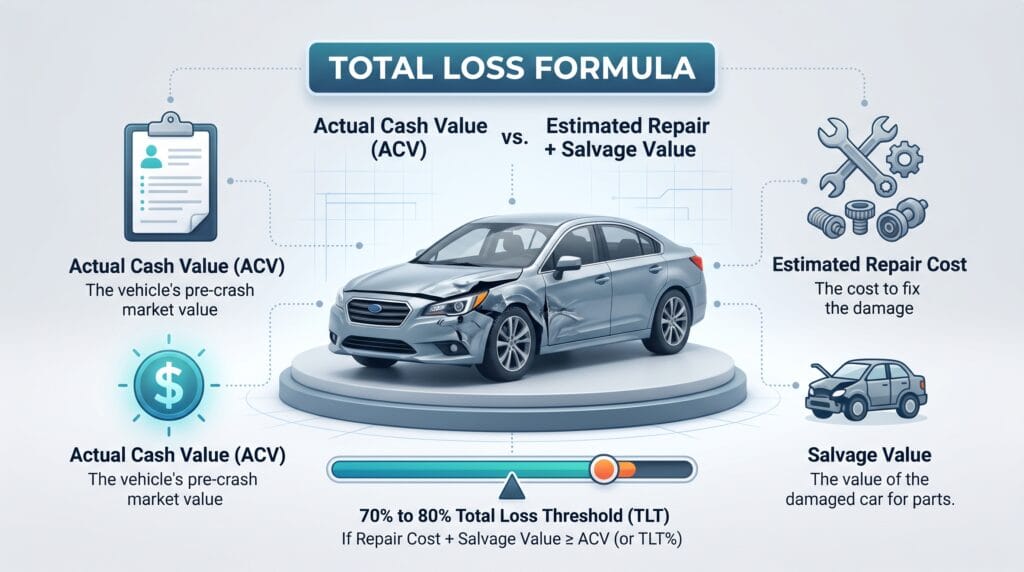
Washington uses a total loss formula, not a fixed percentage. Under RCW 46.04.514, a vehicle is a salvage vehicle when the owner or insurer determines that the cost of parts and labor plus the salvage value makes it uneconomical to repair. Vehicles six or more model years old are generally excluded unless they were worth at least the state’s market value threshold, an amount the Department of Licensing adjusts each year, and are no more than 20 model years old.
Because the formula counts salvage value, a vehicle can be totaled when the repair estimate is well under its value. That makes the valuation the whole fight.
Washington also has some of the most detailed total loss rules in the country. Under WAC 284-30-391, a cash settlement must be based on the actual cash value of a comparable vehicle using current data from the area where your vehicle is principally garaged, and it must include the sales tax and government fees you would have paid to buy that vehicle. Even so, valuation reports often pull comparables from the wrong market, miss trim levels and options, or apply condition deductions that don’t hold up.
Activating the appraisal clause introduces an independent, certified appraiser to legally establish and mandate your vehicle’s true pre-accident worth.
Comparing states? See our total loss threshold by state guide for the rule in all 50 states.
Can You Dispute a Total Loss Offer in Washington?
The Right to Your Own Appraisal: You are not required to accept the insurance company’s first offer.
- The Appraisal Clause: If you and your insurer disagree on the value, you can invoke the “Appraisal Clause” and hire an independent appraiser (Ironclad Claims) to demand a fair settlement.
- Sales Tax & Fees: Under WAC 284-30-391, a Washington total loss settlement must include the applicable sales tax and government fees you would have paid to buy the vehicle. Check that your offer does.
Valuing Totaled Vehicles Across Washington Markets
Washington’s vehicle markets split along the Cascades. The Puget Sound region, from Everett through Seattle, Bellevue, and Tacoma, has deep dealer inventory, and a fair valuation there should draw on comparables a buyer could actually shop in that metro. East of the mountains, Spokane, the Tri-Cities, Yakima, and Wenatchee are separate markets with their own inventory and pricing. Washington’s rule ties the valuation to the area where your vehicle is principally garaged, so comparables from the wrong side of the state deserve a hard look.
In rural areas and smaller towns, local inventory is often too thin to value a vehicle on its own, and comparables have to come from farther away. That is legitimate, but each comparable still has to match your vehicle’s trim, options, mileage, and condition, with every adjustment supported by market data. See our total loss threshold by state guide for how other states compare.
Why we outperform the competition
We know the Washington market.
Local Market Data
We don't use national averages. We look at actual sales data from your Washington market to prove your car's value.
Expert Negotiation
We handle the "Umpire" process and communication with the insurance company.
Proven Results
Our clients see an average increase of $2,500 – $4,500 over the initial insurance offer.
How to dispute a total loss offer
- Contact Ironclad Claims Solutions for a free claim review. We compare the insurer’s valuation to the real market and tell you whether an independent total loss appraisal can increase your settlement.
- After the review, we will assist you with invoking your right to appraisal with your insurance company.
- Your insurance company will then be forced to step out of negotiations and hire a third-party independent appraiser who will work with us to reach an agreement on the value of your vehicle.
Total Loss FAQs
What is the total loss threshold in Washington?
Washington doesn’t use a fixed percentage. Under RCW 46.04.514, a vehicle is a salvage vehicle when the cost of repairs plus its salvage value makes it uneconomical to repair. Because salvage value counts toward that total, insurers can declare a total loss even when the repair estimate is well below the vehicle’s value. That makes the valuation the key number in your claim.
Can I use the appraisal clause on a total loss in Washington?
Usually, yes. Most Washington auto policies include an appraisal provision that either side can invoke when you disagree on the amount of loss, including a vehicle’s actual cash value. The award is binding on that amount. Policy wording varies, so send us yours and we’ll check.
What must a Washington total loss settlement include?
Under WAC 284-30-391, a cash settlement must be based on the actual cash value of a comparable vehicle, using current data from the area where your vehicle is principally garaged. It must also include the sales tax and government fees you would pay to buy that vehicle. If your offer leaves these out or uses comparables from another market, it may be too low. Don’t sign a release or cash a settlement check before getting a free claim review.