Kansas Total Loss Threshold: The 75% Rule and How to Fight a Lowball Offer
Kansas requires a salvage title when repairs reach 75% of your vehicle’s fair market value. Your insurer can still total it below that line, and the offer is often low. We use the Appraisal Clause to close the gap.
Kansas Total Loss Appraisal Clause Services
Settling a total loss auto insurance claim in the Sunflower State requires precise regional market data that national insurance providers routinely ignore. Whether your vehicle was severely damaged on a major transit corridor like I-70, I-35, or the Kansas Turnpike, a high-traffic metro highway in Wichita or Overland Park, or during severe regional weather, accepting your insurance company’s initial valuation offer is a mistake. Insurance adjusters consistently rely on automated, generalized valuation reports that fail to reflect the actual cash value of well-maintained vehicles in our unique state market. At Ironclad Claims Solutions, we specialize in helping Kansas drivers invoke the appraisal clause built directly into their auto policies, stripping the negotiation power away from the insurance adjuster and demanding a binding settlement based on true local data.
Understanding the Kansas Total Loss Threshold.
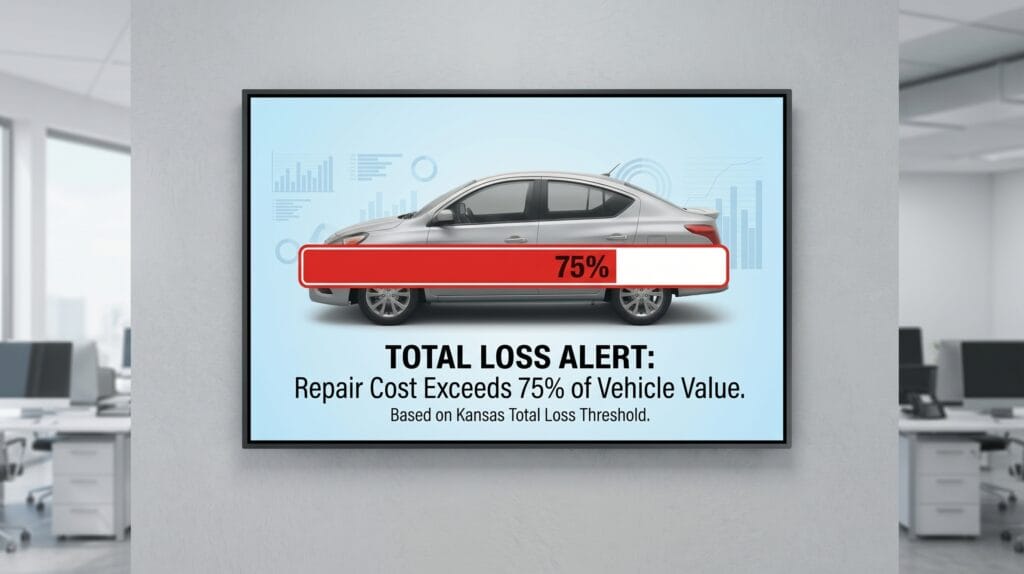
Kansas’s threshold is set by K.S.A. 8-197. A vehicle is a salvage vehicle when the total cost of repair is 75% or more of its fair market value immediately before the damage. Damage that is only exterior cosmetic damage from windstorm or hail does not count. Kansas defines fair market value as retail value from a nationally recognized guide or a market survey of comparable vehicles with similar condition and equipment.
The 75% threshold decides when a vehicle must carry a salvage title. It does not prevent your insurer from declaring a total loss at a lower percentage.
Once a total loss is declared, insurers often rely on third-party valuation software that can undervalue your vehicle. Under K.A.R. 40-1-34 (the Kansas Unfair Claim Settlement Practices Regulation), insurance companies are strictly required to use verified local market comparables, local dealer quotes, or highly localized, statistically valid sources. Furthermore, K.A.R. 40-1-34(d) dictates that any condition, mileage, or prior-damage deductions the adjuster takes must be measurable, discernible, and specified in exact dollar amounts, yet adjusters routinely apply arbitrary, unitemized lump-sum deductions to lower your settlement.
Activating the appraisal clause introduces an independent, certified appraiser to legally establish and mandate your vehicle’s true pre-accident worth.
Comparing states? See our total loss threshold by state guide for the rule in all 50 states.
Can You Dispute a Total Loss Offer in Kansas?
The Right to Your Own Appraisal: You are not required to accept the insurance company’s first offer.
- The Appraisal Clause: Most Kansas policies contain an “Appraisal Clause.” If you and the insurer disagree on the value, you can hire an independent appraiser (Ironclad Claims) to demand a fair settlement.
- Sales Tax & Fees: In Kansas, the insurer must include applicable sales tax, title, and registration fees in the total loss settlement.
Valuing Totaled Vehicles Across Kansas Markets
Kansas vehicle markets range from the Kansas City metro, which straddles the Missouri state line, to Wichita and the smaller communities across the rest of the state. In Johnson and Wyandotte counties, a buyer replacing a totaled vehicle shops dealers on both sides of State Line Road, so a fair valuation can draw on the full Kansas City market. We review whether the insurer’s comparables actually reflect that market, or whether they lean on lower-priced listings from wherever the software found them.
In smaller Kansas markets, local inventory is often too thin to value a vehicle on its own, and comparables have to come from Wichita, Kansas City, or neighboring states. That is legitimate, but each comparable still has to match your vehicle’s trim, options, mileage, and condition, with every adjustment supported by market data. See our Missouri and Oklahoma pages for neighboring markets.
Why we outperform the competition
We know the Kansas market.
Local Market Data
We don't use national averages. We look at actual sales data from Kansas to prove your car's value.
Expert Negotiation
We handle the "Umpire" process and communication with the insurance company.
Proven Results
Our clients see an average increase of $2,500 – $4,500 over the initial insurance offer.
How to dispute a total loss offer
- Contact Ironclad Claims Solutions for a free claim review to determine how much more we can increase your settlement.
- After the review, we will assist you with invoking your right to appraisal with your insurance company.
- Your insurance company will then be forced to step out of negotiations and hire a third-party independent appraiser who will work with us to reach an agreement on the value of your vehicle.
Total Loss FAQs
What is the total loss percentage in Kansas?
It is 75%. Under Kansas law (Kan. Stat. Ann. § 8-197), if the estimated cost of repairing the vehicle physically equals or exceeds 75% of its actual cash value (ACV) prior to the accident, the insurance carrier must legally declare it a total loss and issue a salvage title.
Does Kansas require insurance to pay sales tax on totaled cars?
Yes. Under Kansas Unfair Claim Settlement Practices rules (K.A.R. 40-1-34), total loss settlements must be based on the actual cash value of a comparable vehicle in the local market. To fairly compensate you, the settlement must account for applicable state and local sales taxes, title fees, and transfer costs required for you to successfully purchase a replacement vehicle.
How long do I have to dispute a total loss claim in Kansas?
While you should always invoke your policy's appraisal clause immediately to avoid compounding storage and administrative fees, the statutory deadline for formally filing an auto property damage claim or civil lawsuit regarding vehicle damage in Kansas is two (2) years from the exact date of the accident under K.S.A. § 60-513.